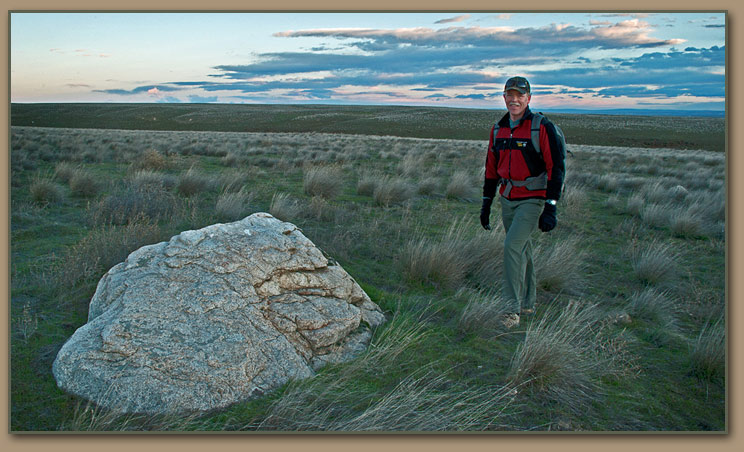
Palouse Falls panorama Bitterroot Blooms Giant Current Ripple - Camas Prairie Montana Glacial Lake Missoula Bison Ice Rafted Erratic Wallula Gap
HUGEfloods.com Home Page Not much time? ... Click here for a quick Ice Age Floods summary Ice Age Floods Feature of the month For many years one man understood the clues but no one would listen Glacial Lake Missoula Channeled Scablands of Eastern Washington Temporary Lake Lewis Columbia Gorge Explore the variety of features created by the Ice Age Floods Columbia River Basalt Group The Pleistocene Grand Coulee Dam and the Columbia Basin Irrigation Project Washington Wines Ice Age Floods Institute Palouse Falls Kayak.

Discover the Ice Age Floods

The catastrophic floods from Glacial Lake Missoula and Lake Bonneville
are among the largest known floods in geologic history

Note from Tom: Existing text on this intro page will be moved to the Express section and mixed with photos. New content will be posted on this page. Should have things moved soon.

Ice Age Floodwater flows over the area known today as Dry Falls.
Image shows Ice Age Floodwaters flowing through Lower Grand Coulee.


Information about the artist: Stev H. Ominski


The Story of the Glacial Lake Missoula Floods

BEFORE THE ICE-AGE FLOODS CAME...THE LAVA FLOWED

About 17 million years ago floods of lava began coating the Columbia Basin of Washington--as well as northeast Oregon, and the Columbia Gorge region all the way to the Pacific Coast. Originating from hundreds of lengthy fissures in northeast Oregon, as many as 300 separate floods deposited thick lava beds over 60,000 square miles. The lava outbreaks ceased about 6 million years ago. Each lava flood cooled and hardened into dark basalt rock which accumulated to a mile in depth throughout much of the region.

GLOBAL COOLING THEN BRINGS AN ONSLAUGHT OF ICE-AGE GLACIERS

Between 2 million and 2.5 million years ago a combination of cooler temperatures and increased precipitation formed massive ice sheets which repeatedly advanced and retreated as climate conditions fluctuated. Ice coated the Puget Sound lowlands, and most of the mountain regions of northern Washington, Idaho and Montana. So much glacial ice existed that the oceans were 300 feet lower than they are today. The final episode was the Wisconsin glaciation, a cycle that took place from 100,000 years ago until about 10,000 years ago.

ICE DAMS BLOCK MOUNTAIN VALLEYS, CREATING SUPER-RESERVOIRS

As the ice sheets pushed southward from Canada they interrupted normal stream flows in the deep valleys of the mountainous Pacific Northwest. One protrusion, the Okanogan Lobe, created Lake Columbia, which was a super-sized version of modern Lake Roosevelt. An ice mass clogging the Purcell Valley of Idaho's panhandle blocked the outflow of the Clark Fork River, forming Glacial Lake Missoula. Other impoundments included a lake near Spokane, Wash. Scientists believe that additional lakes existed in Washington, Montana and British Columbia.

LAKE MISSOULA BECOMES A CATALYST FOR A CATASTROPHE

The ice blockage in the Purcel Valley gradually collected tremendous volumes of water in the deep valleys of western Montana, creating a gigantic reservoir which attained a depth of 2,000 feet and impounded over 500 cubic miles of water--equivalent to the combined volumes lakes Erie and Ontario. The natural ice dam periodically failed, which caused a catastrophic emptying of Lake Missoula. After each dam failure, the southward moving ice sheet then created a new one, and the cycle repeated itself. At least 40 major flood episodes originated from Lake Missoula.

FLOOD TORRENTS DRASTICALLY ALTER THE LANDSCAPE

Each ice dam failure released a torrent of of water hundreds of feet deep, which swept southwesterly--gouging the huge coulees of eastern Washington, ripping out sediment and basalt rock, and stripping soil and vegitation from thousands of square miles of land in the Columbia Basin. Some of the debris was carried by the floods all the way to the ocean. One flood pathway created the Grand Coulee. A second poured into the lowlands around Ephrata, Moses Lake and Othello. A third flowed along the western fringe of the Palouse Hills, removing vast amounts of fertile topsoil. More than 2,000 squre miles of so-called "scablands" were created. Each flood episode added to the impact.

WALLULA GAP STEMS THE DELUGES TEMPORARILY

The Lake Missoula floods overwhelmed everything in their path until they reached the choke point at Wallula Gap in the Horse Heaven Hills range south of Pasco, Wash. Floodwaters backed up throughout the Pasco Basin and Yakima and Walla Walla valleys. The result was a temporary impoundment known as Lake Lewis, which existed for only a few days after each major flood episode. During its brief existences Lake Lewis put 3,000 square miles of land under water, and the lake was more than 800 feet deep in Pasco.

WALLS OF WATER THEN RAGE THROUGH THE COLUMBIA GORGE

Water volumes exceeded the capacity of the gorge near today's John Day Dam, creating another impoundment which backflooded into the Dalles and Umatilla basins. Surging water gouged the walls of the gorge to their modern near-vertical alignment, thereby creating the complex of waterfalls at the gorge's west end. Patches of scabland were created near the Dalles and extensive sand and gravel bars were dropped into the valleys of tributary streams.

THE FLOODS RUSH TO THE OCEAN, WHILE BRIEFLY DROWNING THE WILLAMETTE VALLEY

Another check point at Kalama caused the floods to form another temporary lake which flooded the Willamette Valley as far south as Eugene, Ore. Large lowland tracts in Washington across the river from Portland also were underwater. The flood crests then dropped rapidly as they reached Astoria and the Ice-Age seacoast 40 miles west of that modern city. Flood debris has accumulated to a depth of 800 feet in the Columbia River's bed west of Astoria.

THE ICE-AGE FLOODS LEAVE STARK EVIDENCE OF THEIR PASSAGE

In addition to the mammoth coulees of eastern Washington, direct evidence of the floods exist in several forms. Giant current ripples, such as those at West Bar, near Quincy, Wash., and at Camas Prairie, Mont. , offer some of the most conclusive proof that the massive flooding occurred. Other flood-caused phenomena include massive bars of sediment at various locations along the Snake and Columbia rivers...the scoured buttes, basins, and potholes of the scablands...impressive recessional cataracts at Dry Falls and Palouse Falls...and boulders transported hundreds of miles on ice rafts.

HOW DO WE KNOW THAT THESE DRAMATIC FLOODS OCCURRED?

The pioneering research carried out by geologist J Harlen Bretz in numerous treks through the Columbia Basin region beginning in the 1920s convinced him that only huge floods--not normal erosion processes--could have wreaked so much havoc upon the area's landscape. But most leading geologists scoffed at his findings. Not until the 1950s, after additional research by Bretz, coupled with that of geologists Joseph T. Pardee, did opinions begin to change. Pardee proved that glacial Lake Missoula was the source of the floods. Bretz's controversial thesis was vindicated fully by the mid-1960s.

WHAT IS THE ICE AGE FLOODS INSTITUTE?

The Ice Age Floods Institute is a non-profit organization dedicated to promoting public awareness and understanding of the full story of the Ice Age flood, and of their effect upon the region's natural and cultural history. Chapters are active in Washington, Oregon, Montana and Idaho. The organization may be contacted at: Ice Age Floods Institute


ICE AGE FLOODS MYSTERY

The idea of catastrophic flooding ran counter to the conventional wisdom of scientists, but over a 30-year period geologist J Harlen Bretz proved that the remarkable natural features of the Columbia Basin could only have occurred in this way. Fellow geologist Joseph T. Pardee identified the role of Lake Missoula in the process.


Satellite image of Washington State
NASA images show path of the Ice Age Floods

- Click to enlarge satellite images -

Columbia Basin Satellite Image, Click to Enlarge.
Columbia Basin Detail
Add satellite description.


View Larger Map

LAKE BONNEVILLE FLOOD

Snake River Canyon

Another Ice-Age phenomenon was Lake Bonneville, which during that era covered much of northern Utah as precipitation and meltwater gradually filled a large natural lowland. The lake eventually attained a surface area roughly equal to modern Lake Michigan, and a depth of more than 1,000 feet, because it had no natural drainage outlets. Unlike Lake Missoula, ice dams were not an issue at Lake Bonneville. Its most vulnerable point was a natural dam of alluvial material blocking Red Rock Pass in southeastern Idaho.

About 15,000 years ago that dam gave way and the level of Lake Bonneville dropped more than 350 feet in one spectacular episode. Over time about 1,000 cubic miles of water roared through the Snake River Canyon and emptied into the Columbia River near Pasco, WA. Stark evidence of the flood remains in the form of smooth displaced boulders (melon gravels), scablands and gravel bars. Utah's Great Salt Lake now occupies a portion of the land area once covered by Lake Bonneville.

More information and photos:
Lake Bonneville Flood

Melon Gravels

Columbia River Basalt in Drumheller Channels, shaped by the Ice Age Floods.

All photos by Tom Foster unless otherwise noted.

HOME Space CONTACT Space SITE MAP IAFI Space LINKS Space © 2008
Ellensburg
Lake Missoula
Lake Lewis
Ice Age Blog
Ice Age Express
Feature of the Month
The Mystery
25 Features
Channeled Scablands
Ice Age Floods Videos
Columbia Gorge
Feature Types
Columbia River Basalt
The Pleistocene
Grand Coulee Project
Washington Wine
Ice Age Floods Inst.
The Bonneville Flood